
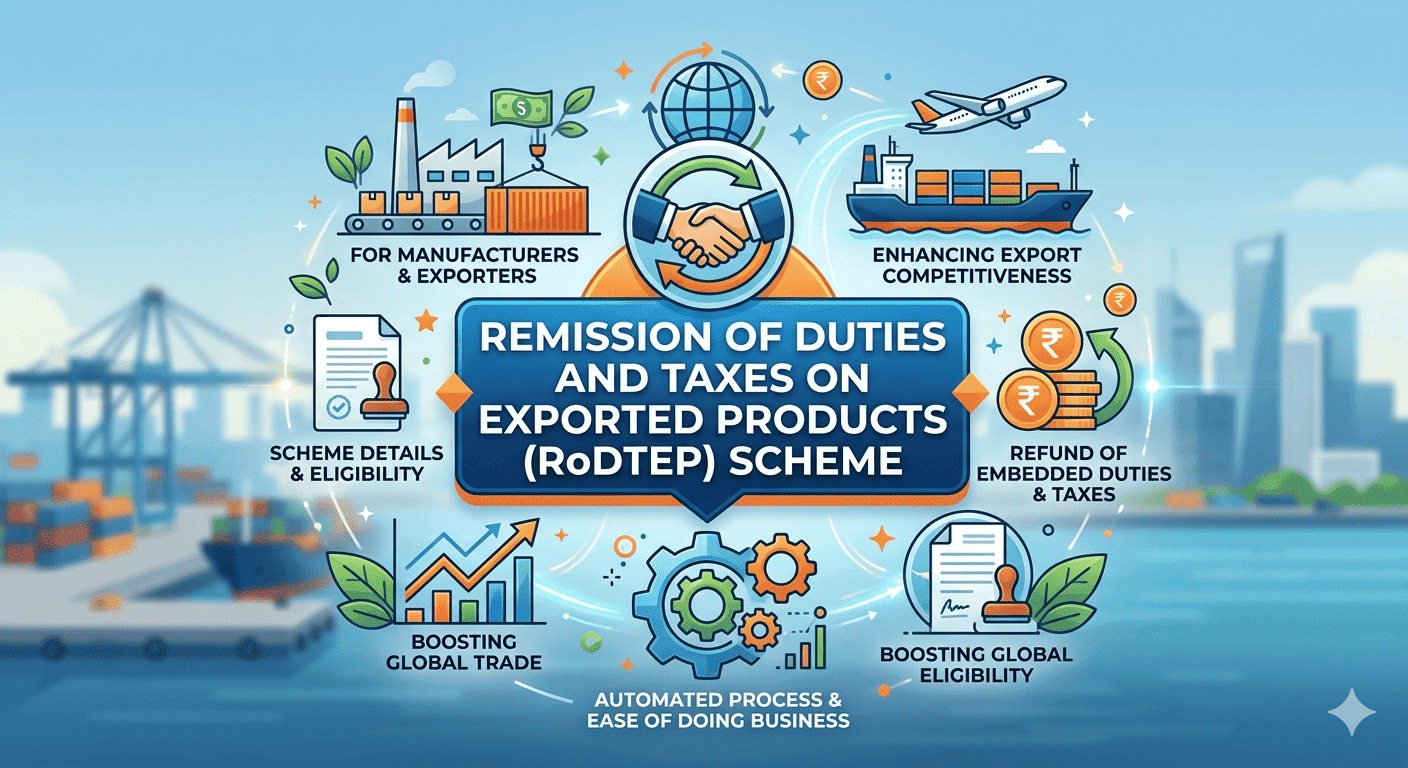
For an Indian MSME, the goal is simple: produce quality goods and sell them globally. However, “hidden” costs like local taxes, electricity duties, and fuel cess often make Indian products pricier than international competitors. The RoDTEP scheme (Remission of Duties and Taxes on Exported Products) is the government’s answer to this challenge. It ensures that taxes are not “exported” with the product, making your goods more competitive in the global market.
What is the RoDTEP Scheme?
Launched to replace the older MEIS (Merchandise Exports from India Scheme), RoDTEP is a WTO-compliant mechanism. It refunds the embedded central, state, and local duties that were previously non-refundable under any other scheme.
Key Taxes Covered Under RoDTEP:
- Fuel Taxes: VAT and Excise duty on fuel used in transportation and machinery.
- Electricity Duty: Taxes paid on the purchase of electricity for manufacturing.
- Local Levies: Mandi tax, municipal taxes, and property taxes.
- Stamp Duty: On export-related documentation.
Latest Updates (April 2026)
As of April 1, 2026, the Directorate General of Foreign Trade (DGFT) has extended the existing RoDTEP rates and value caps until September 30, 2026. This provides much-needed policy certainty for MSMEs to sign long-term export contracts without worrying about sudden cost escalations.
Why RoDTEP Scheme is a Game-Changer for MSMEs
- Price Competitiveness: By refunding 0.3% to 4.3% of the FOB (Free on Board) value, MSMEs can lower their final export price.
- Improved Cash Flow: The rebate is issued as transferable e-scrips, which can be used to pay basic customs duty or sold to other importers for cash.
- Broad Eligibility: Unlike some older schemes, RoDTEP is available to both manufacturer exporters and merchant exporters.
- Inclusion of SEZs/EOUs: Units in Special Economic Zones (SEZs) and Export Oriented Units (EOUs) are now eligible to claim these benefits.
How to Claim RoDTEP Benefits: A Step-by-Step Process
For MSMEs, the process is fully digital and integrated with the ICEGATE portal.
- Declaration on Shipping Bill: While filing your Shipping Bill, you must explicitly declare your intent to claim RoDTEP for each item by using the code ‘RODTEPY’.
- Processing by Customs: Once the Export General Manifest (EGM) is filed, the system automatically processes your claim.
- E-Scrip Generation: After processing, a “scroll” is generated. You can then create a RoDTEP Credit Ledger on the ICEGATE portal using your Digital Signature Certificate (DSC).
- Utilization: The credits will appear in your ledger. You can use them to pay duties on future imports or transfer them to another GST-registered entity.
Eligibility Checklist for MSMEs
To ensure you don’t miss out, verify the following:
- Country of Origin: The goods must be manufactured in India.
- IEC Code: You must have a valid Import-Export Code.
- HS Code: Check Appendix 4R on the DGFT website to find the specific rate for your product’s 8-digit HS code.
- Exclusions: Be aware that “deemed exports” and products restricted or prohibited for export are generally not eligible.