
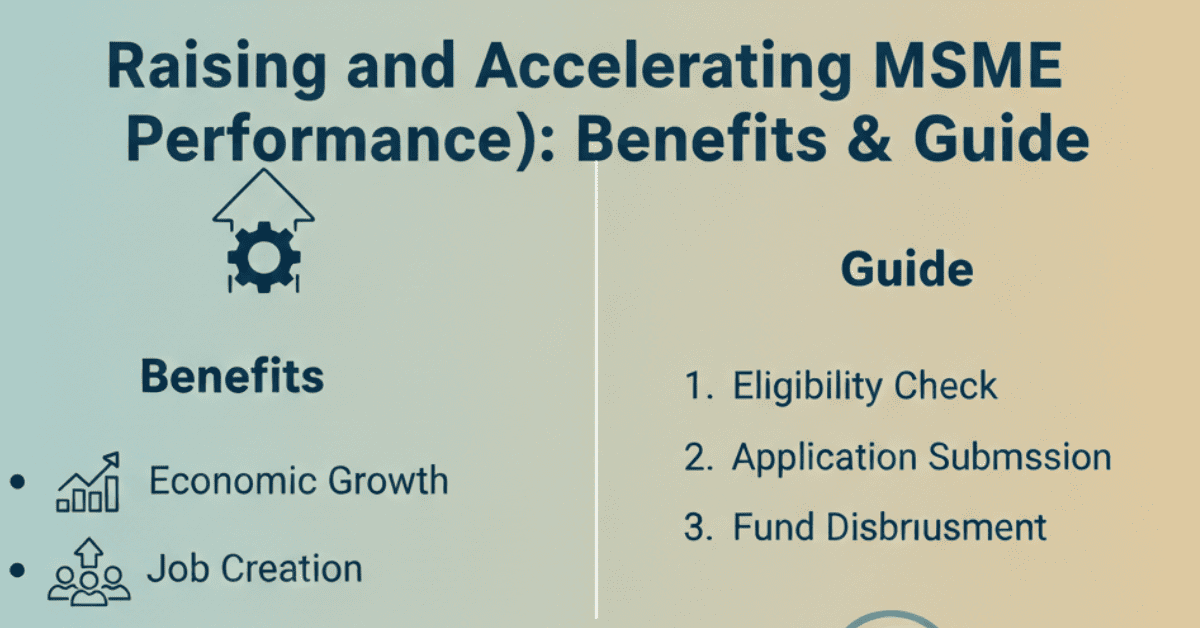
Micro, Small and Medium Enterprises (MSMEs) are the backbone of the Indian economy, contributing significantly to employment, exports, and GDP. To strengthen this sector and address long-standing challenges such as limited access to markets, technology gaps, and capacity constraints, the Government of India launched the Raising and Accelerating MSME Performance (RAMP Scheme).
What is the RAMP Scheme?
Launched with the assistance of the World Bank, RAMP is a Central Sector Scheme designed to strengthen the institutional framework for MSMEs in India. With a total outlay of ₹6,062.45 crore, the program is scheduled to run until the end of the 2026-27 financial year.
The primary goal is to improve access to markets and credit, strengthen institutions at the State and Central levels, and address the critical issue of late payments.
Objectives of the RAMP Scheme
The RAMP scheme has been designed with clear and outcome-oriented goals:
- Strengthen MSME institutions and governance
- Improve access to finance and markets
- Promote technology adoption and innovation
- Encourage formalisation and compliance
- Enhance state-level MSME ecosystem
- Improve ease of doing business for MSMEs
The ultimate objective is to help MSMEs become more productive, competitive, and globally integrated.
Major Sub-Schemes Under RAMP
To provide targeted support, the RAMP initiative includes several specialized programs that MSMEs can leverage:
- MSME TEAM (Technology Equity and Advanced Marketing): This focuses on digital onboarding. It helps MSMEs integrate with the Open Network for Digital Commerce (ONDC) to reach a wider customer base.
- MSE-GIFT (Green Investment and Financing for Transformation): Aimed at sustainability, this scheme provides interest subvention and credit guarantees for businesses adopting energy-efficient technologies.
- MSE-SPICE (Scheme for Promotion of Investment in Circular Economy): This sub-scheme supports MSMEs in adopting circular economy models, such as recycling and waste management, through capital subsidies.
- MSE-ODR (Online Dispute Resolution): A digital platform designed to fast-track the resolution of delayed payment disputes between MSMEs and buyers.
How RAMP Benefits MSMEs
Although MSMEs may not receive direct subsidies, they gain in multiple indirect but powerful ways:
Improved Access to Finance
- Stronger credit guarantee mechanisms
- Better risk assessment frameworks
- Improved lender confidence in MSMEs
Enhanced Market Access
- Support for export readiness
- Integration with GeM and digital marketplaces
- Improved buyer-seller linkages
Technology & Innovation Support
- Promotion of digital tools
- Encouragement for Industry 4.0 adoption
- Support for innovation and quality standards
Ease of Doing Business
- Simplified compliance frameworks
- Better grievance redressal systems
- Digitalisation of MSME services
Who Can Benefit from the RAMP Scheme?
The RAMP scheme benefits the entire MSME ecosystem, including:
- Micro, Small & Medium Enterprises
- MSME facilitation centres
- Industry associations
- State MSME departments
- Financial institutions supporting MSMEs
- Startups transitioning into MSMEs
All Udyam-registered enterprises stand to gain from improved policies, platforms, and institutional support created under RAMP.
Role of States Under RAMP
States play a crucial role in implementing RAMP by:
- Designing MSME reform action plans
- Improving state-level MSME policies
- Strengthening District Industries Centres (DICs)
- Promoting local MSME clusters
States achieving better reform outcomes receive higher performance-linked funding, creating healthy competition and faster improvements.